
Adult (16+) traffic classes for new cyclists, experienced cyclists, and drivers
Class info:
- When: Classes are held as-requested, on weekday evenings and weekends.
- Where: Typically at the South Waterfront, near the West side of Tillikum Bridge, in Portland, Oregon. Exact location varies.
- How to schedule: Email your availability and phone number to vivek@portlandbicycleschool.com. We’ll call for a free 10 minute consultation to learn your needs and determine a schedule.
- Can this content be compressed and delivered to your organization (example: Can I give a 90 minute bike safety talk to college students)? Yes. Email your idea to vivek@portlandbicycleschool.com.
- Payment methods: Cash, check, Venmo, or Paypal required prior to class.
Safety Theory and Laws
The most important class!
Who should take this:
– Anyone who teaches bike safety to more than 1 person, especially in a professional capacity.
– Cyclists of all experience level.
– Drivers of all levels… this re-hashes much of Drivers Ed. Statistically, drivers make the majority of mistakes that lead to crashes and death.
– Parents concerned with their kids on ebikes, or other motorized mobility devies.
Why:
– Learn laws and best practices that most cyclists and drivers don’t know.
– Prevent crashes. Decrease your number of daily near-misses.
– Give you confidence to bike and drive safely.
– Transform the way you drive, bike, and walk.
– Every concept will be new to you unless you’ve memorized the Drivers Manual, studied traffic theory, read crash report studies, and read legal text and attorney analysis. No amount of on-road experience equates to learning these.
What this is:
– Lecture in classroom. Students take notes and have a test at the end.
– 3 classes, 90 minutes each. Each class requires homework: 2 hours of reading.
– What to bring: What you need to take notes. An electronic device is helpful for reading laws and looking up resources.
Cost:
$60/hour for 1-on-1 instruction. $40/hour if there are multiple paying students. Sliding scale for hardship. Ask for employer rate, if your employees teach or require bike safety.
Content: Take a classs if you can’t answer any of these crucial skills
– what is the Basic Rule? Why do we say “20’s Plenty?”
– what is a crosswalk? Hint: it’s not defined by white lines
– what are the 3 types of passes? What are the steps of a pass? What is lanesplitting, and why is it deadly in a car?
– do you know who must yield in daily scenarios between cyclists/pedestrians/drivers?
– do you know the pros and cons of cycling in bike lanes, sidewalks, and traffic lanes?
– under what conditions are cyclists creating a substantial delay that “impedes” drivers?
– are cyclists allowed on sidewalks or outside of bike lanes?
– why do cyclists “take the lane”?
– what are the top causes of crashes, so you know how to focus?
– what steps can you take to prevent crashes as drivers and cyclists? Hint: we regularly hear myths (ie, wrong answers) such as “slow down” or “ride like no one sees you”.
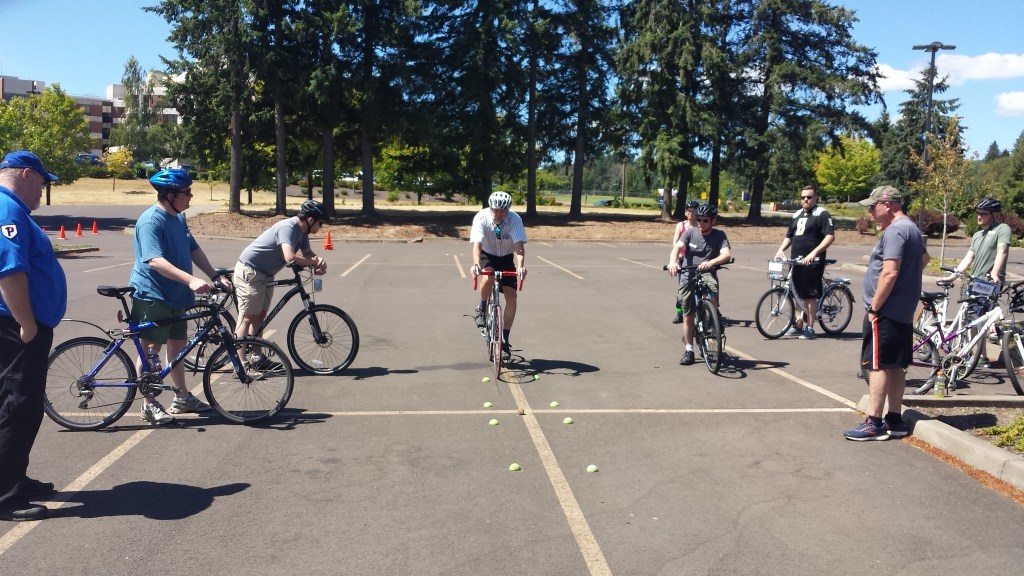
Beginner cyclist, parking lot drills
For new cyclists who don’t feel steady, or have difficulty balancing:
- Learn how to mount a bicycle, balance, smooth starting, braking, shifting, turning, looking over your shoulder (3 techniques), and moving quickly through large intersections (simulation).
- Taught outdoors on a car-free street. Bring your bike and helmet.
- Takes 1-3 hours, depending on your skill level. We can meet once or multiple times.
- $45/hour for 1-1 instruction. $30/hour if there are multiple paying students. Sliding scale available for hardship.
- Experienced cyclists will learn a few techniques, sprinkled throughout.
Classroom Discussion: Practical frequently asked questions
For new or intermediate cyclists
- Content: How to chose a bicycle that fits you, parts of a bicycle, how to determine if a bicycle is safe to ride, helpful clothing and equipment, advanced techniques for locking a bicycle, and how to wear a helmet properly.
- Taught indoors in a classroom.
- Takes ~2 hours, depending on questions
- $30/hour. Sliding scale available for hardship.
- What to bring: it helps if you bring your bike and your locks. Otherwise, nothing is needed.
Bicycling around town with an instructor
For new to intermediate cyclists
- Learn various traffic infrastructures
- Learn to identify hazards, and how to navigate them
- How to get groceries, haul kids, and commute to work
- How to find a route in Portland
- If you need it, we’ll take you on a busier road and practice “taking the lane”
- Taking your bike on transit
- Experienced cyclists have things to learn
- What to bring: your bike and helmet
- Takes 2-3 hours, depending on your needs
- $45/hour for 1-on-1 instruction, $30/hour for multiple paying students. Sliding scale available for hardship.
NEW 2026: Pedestrian Safety Theory & Laws
For anyone who wants to prevent pedestrian crashes. Especially professional educators.
Why:
– A deeper dive than Drivers Ed. Statistically, drivers cause the majority of crashes.
– Info for pedestrians too.
– Every concept will be new to you unless you’ve memorized the Drivers Manual, studied traffic theory, read crash report studies, and read legal text and attorney analysis. No amount of on-road experience equates to learning these.
What this is:
– Lecture in classroom. Students take notes and have a test at the end.
– 2 classes, 90 minutes each. Each class requires homework: ~90 minutes of reading.
– What to bring: What you need to take notes. An electronic device is helpful for reading laws and looking up resources.
Cost:
– $60/hour for 1-on-1 instruction. $40/student/hour if there are multiple students. Sliding scale for hardship.
– Ask for employer rate, if your employees teach behaviors for pedestrian safety.
Content: Take a classs if you can’t answer any of these crucial skills
– what is the Basic Rule? Why do we say “20’s Plenty?”
– what is a crosswalk? Hint: it’s not defined by white lines
– at unmarked crosswalks, when must drivers stop for pedestrians? Hint: it’s not when a pedestrian walks or stands near the crosswalk.
– how long must drivers stay stopped for pedestrians in crosswalks?
– why is it illegal and dangerous to park a car near crosswalks? What is the legally required distance between a parked car and the crosswalk?
– are cyclists allowed in crosswalks?
– how can drivers notice pedestrians in crosswalks? Hint: techniques from Drivers Ed. Wrong answers are “pedestrian wears bright clothing”.
– what are the laws for yielding to blind pedestrians?
 Adult classes for new & experienced cyclists, and drivers. In Portland, Oregon.